

Interview with Adriana Rivas
In August 2013, while investigating Australia’s involvement in the destabilisation of Salvador Allende’s government and the 1973 Chilean coup for the SBS Spanish investigation The Other 9/11, someone from Chile suggested that Adriana Rivas was living in Sydney. Rivas was a former agent of Chile’s notorious secret police, the DINA, and was wanted by Chilean authorities in connection with the kidnapping and disappearance of seven political opponents of the Pinochet dictatorship.
I found Rivas and secured an exclusive interview with in August 2013, after months of conversations. Her view was that the story of the dictatorship was skewed and that media was not representing the facts. I offered to present her view, as I had done before with Uruguayan officials in detention. She agreed, she wanted to tell her side of the story.


The interview became significant far beyond the original historical investigation because of the extraordinary detail and candour of Rivas’s account. Although she denied participating in the crimes of which she was accused, she confirmed her role within the DINA, discussed the organisation and its activities, and openly defended the dictatorship’s use of torture. She said that torture was widely known within the regime and described it as necessary to break political opponents, saying it was “the only way to break people.”
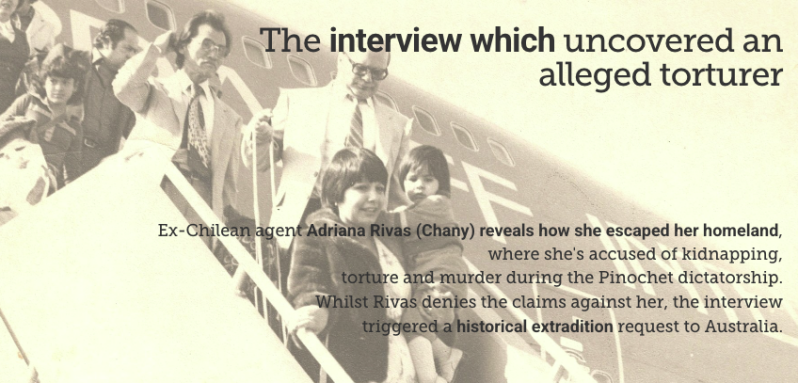
Most importantly from a legal perspective, Rivas described in detail how she had escaped from Chile while facing criminal proceedings. She explained that after being released on bail she obtained financial and logistical help from friends, crossed the Andes clandestinely into Argentina, travelled through Mendoza to Buenos Aires and boarded a flight to Australia. She effectively provided, in her own words, an account of how she had left Chile illegally and returned to Sydney.
The interview therefore transformed a historical investigation into something with immediate legal consequences. Rivas’s own testimony became crucial evidence enabling Chilean authorities to pursue her in Australia and initiate an extradition request. Chile formally requested her extradition in 2014. After a lengthy process, Australian authorities arrested Rivas in Sydney in February 2019 to face extradition proceedings over aggravated kidnapping allegations relating to seven victims of the dictatorship.
The interview demonstrated how investigative journalism can connect historical accountability with contemporary evidence. I had originally been investigating Australia's largely hidden intelligence relationship with Chile, including the presence of Australian intelligence officers in Santiago working in support of CIA operations before the coup. Finding Rivas revealed another dimension of that history: people associated with the Pinochet security apparatus had subsequently made their lives in Australia. The investigation consequently raised broader questions about how former intelligence agents and alleged perpetrators of dictatorship-era crimes came to Australia, what Australian authorities knew about them, given that Rivas was one in a list of 8 officials related to the Pinochet regime, hiding in Australia.
The interview became significant far beyond the original historical investigation because of the extraordinary detail and candour of Rivas’s account. Although she denied participating in the crimes of which she was accused, she confirmed her role within the DINA, discussed the organisation and its activities, and openly defended the dictatorship’s use of torture. She said that torture was widely known within the regime and described it as necessary to break political opponents, saying it was “the only way to break people.”
Most importantly from a legal perspective, Rivas described in detail how she had escaped from Chile while facing criminal proceedings. She explained that after being released on bail she obtained financial and logistical help from friends, crossed the Andes clandestinely into Argentina, travelled through Mendoza to Buenos Aires and boarded a flight to Australia. She effectively provided, in her own words, an account of how she had left Chile illegally and returned to Sydney.
The interview therefore transformed a historical investigation into something with immediate legal consequences. Rivas’s own testimony became crucial evidence enabling Chilean authorities to pursue her in Australia and initiate an extradition request. Chile formally requested her extradition in 2014. After a lengthy process, Australian authorities arrested Rivas in Sydney in February 2019 to face extradition proceedings over aggravated kidnapping allegations relating to seven victims of the dictatorship.
The interview demonstrated how investigative journalism can connect historical accountability with contemporary evidence. I had originally been investigating Australia's largely hidden intelligence relationship with Chile, including the presence of Australian intelligence officers in Santiago working in support of CIA operations before the coup. Finding Rivas revealed another dimension of that history: people associated with the Pinochet security apparatus had subsequently made their lives in Australia. The investigation consequently raised broader questions about how former intelligence agents and alleged perpetrators of dictatorship-era crimes came to Australia, what Australian authorities knew about them, given that Rivas was one in a list of 8 officials related to the Pinochet regime, hiding in Australia.
Secrets We Keep (LISTNR, 2026)
Host: Joey Watson
Producer: Claudianna Blanco

