Communicating Uncertainty
in Journalism
Impartiality has come under considerable criticism in journalism. While some of that criticism is justified, the problem is not necessarily impartiality itself, but how impartiality has been executed. The concept sustaining impartiality is rarely contested, as it implies asking journalists to remain independent of the interests, perspectives and assumptions of the people and institutions they report on, and to approach evidence without predetermining the conclusion. This standard and practice are linked to credibility and ultimately, trust.
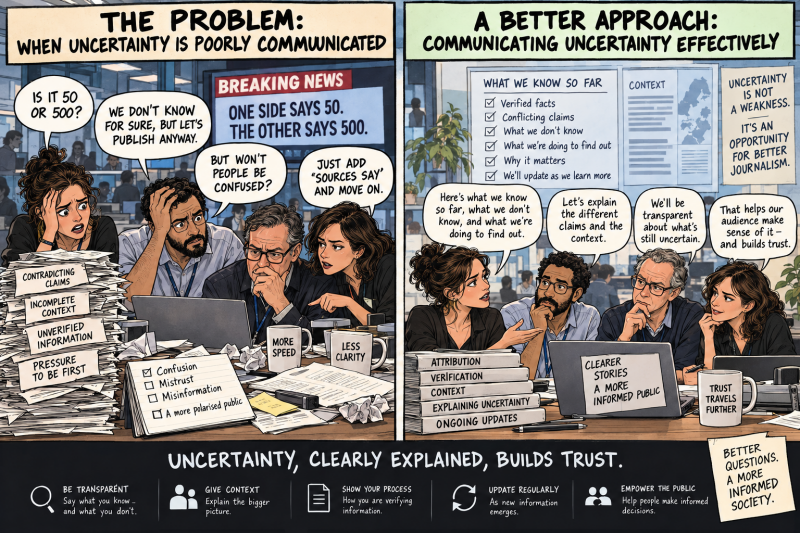
But impartiality can become distorted when it's reduced to balance: one claim against another, one side against another, two competing accounts presented as if the existence of disagreement itself establishes equivalence. This is the familiar problem of both-sidesism, false balance or false equivalence, born of how media respond to unresolved factual problems: instead of communicating that uncertainty, they present both voices, conflating facts and perspectives, which are different editorial problems. This article tries to untangle this issue.
The answer does not seem to be to abandon impartiality, though, but to practise it better. A way of doing that is to communicate uncertainty and make it a core standard of impartial journalism.
Accuracy requires journalists to get the facts right. Verification establishes what we know and the evidentiary basis for knowing it. Appropriate weight requires journalists to assess the significance and strength of available evidence. Balance and diversity ensure that relevant perspectives, experiences and interpretations are represented fairly. The problems seem to arise when these different functions become blurred because there's disagreement about what happened. When the facts themselves cannot yet be established, adding perspectives doesn't resolve the evidentiary problem. Faced with something we cannot verify, we sometimes resort to balance: one party says X. Another says Y.
It's understandable why journalists and organisations do this. Attribution is essential, particularly in breaking news, conflict, government reporting and other circumstances where independent verification can be extremely difficult. It prevents journalists from presenting somebody else’s assertion as their own established fact.
But attribution is not verification, and balance is not a substitute for evidence.
Imagine that one party says 50 people were poisoned and another says 500. Reporting both figures with clear attribution may be technically accurate: it's true that each party made those claims. But the audience still does not know what the journalist knows about the underlying event. What evidence supports each figure? What has been independently established? Are the sources equally credible? Is there corroborating evidence? Are there third party sources providing further evidence? Is one figure substantially better supported? Or is the available evidence genuinely insufficient to determine which is more accurate?
Simply presenting both claims can therefore become a shortcut around a much more difficult editorial responsibility. In some cases, it can produce precisely the opposite of impartiality, and this is why impartiality has been under fire. If the evidence strongly supports one proposition, presenting a poorly supported alternative as its equivalent creates false balance. If the evidence is genuinely inconclusive, choosing one account and presenting it with unwarranted certainty creates a different distortion.
Journalism has another option: communicate accurately what is known and what remains uncertain.
“What we know so far”
Journalism already does this very effectively in some circumstances, like during major unfolding events because it clearly communicates to the audience that the reporting is based on information that has been established to an appropriate standard. "So far" acknowledges that the evidence is incomplete, the situation is developing and our understanding may change. It doesn't make the journalism appear weak, and as we know, audiences often seek out precisely this kind of reporting when confronted with an overwhelming volume of claims, images, commentary and speculation during a crisis.
The principle behind "what we know so far"could be applied much more broadly. Instead of treating it simply as a useful format for an explainer during breaking news, we can understand it as a fundamental discipline of impartial reporting. We can tell audiences what the evidence allows us to know at this point, and be equally clear about what it does not yet allow us to know.
When contentious facts can't be verified, we can communicate uncertainty, which is not the same as attribution. Attribution tells the audience who says something; communicating uncertainty tells the audience how far the available evidence allows us to go.
An editorial thinking sequence could be:
- Source: Who says this?
- Evidence: What supports it?
- Verification: What can we independently establish?
- Certainty: How strong is the available evidence?
- Communication: What language accurately conveys that degree of knowledge to the audience?
Impartiality does not require neutrality towards evidence, which is why journalism doesn't give equivalent weight to propositions that are not equivalently supported by evidence. Climate change provides an obvious example. Once an evidentiary question has been overwhelmingly established, impartiality does not require journalism to manufacture factual uncertainty simply because somebody disputes the evidence.
Public health provides another. During the COVID-19 pandemic and the debates surrounding vaccines, journalism had to distinguish constantly between legitimate scientific uncertainty, evolving evidence, competing policy judgements and assertions that were unsupported by the available evidence.
Conflict reporting presents perhaps the most difficult version of the problem. Independent verification may be impossible, access constrained, information weaponised, casualty figures disputed and credible evidence incomplete. In these cases, communicating uncertainty can help journalists avoid having choose between pretending to know something that cannot be established and retreating into “one side says this, the other says that”.
We can say what the evidence shows, what it suggests, what we cannot independently establish, and explain why. Most media have incorporated some of these steps, but not all, not consistently, and mostly linked to accuracy, not impartiality. Being explicit about uncertainty is not only a standard of higher credibility, it also creates a transparent framework for journalism to evolve the story as evidence becomes available, without contradicting previous reporting.
Separating evidence from perspective is a better way of applying the principle of impartiality. Questions of fact should primarily be resolved through evidence, verification, accuracy and transparent communication of uncertainty. Questions of meaning, interpretation, experience, consequence and judgement require diversity of relevant perspectives and appropriate balance. This distinction is not always clear-cut as journalism deals with complex realities, but maintaining it as an editorial principle matters, because it guides newsroom conversations and avoids using perspectives to fill gaps in evidence.
Audience expectations: impartiality (and perception of impartiality) in an environment of information abundance
Audiences are no longer dependent on a small number of news organisations for access to information. They find government statements directly, eyewitness accounts, specialist analysis, satellite imagery, social posts, advocacy, leaked material, misinformation, disinformation and competing news reports, often before a journalist has published anything.
This is one of the reasons why the role of trustworthy journalism is increasingly important. More voices and more evidence don't necessarily create greater clarity. Audiences may also have found credible information that differs from what they subsequently hear from a news organisation. If journalism simply dismisses that discrepancy or asserts certainty without showing its evidentiary basis, it can undermine perceptions of impartiality. Audiences expect more from journalism than simply telling them what happened; they want clarity about what the journalist knows, what evidence supports it, what cannot yet be established, and why.
The point of this article is to help us think together about how we honestly and accurately communicate to audiences the limits of verification, in a way that does not contradict what audiences are watching, reading and hearing on social media, and that helps them make sense of the world. Communicating uncertainty can help journalism avoid false certainty (claiming more certainty than the evidence allows), false uncertainty (creating more doubt than the evidence warrants), and false balance (giving equal weight to claims that are not equally supported by evidence), while giving audiences the clarity they increasingly expect in a fragmented information environment.
Perhaps “What we know so far” is not just a useful headline for an unfolding story, but an expression of a much broader journalistic principle: being clear about what we know, what we do not know, and what we are still trying to establish.
In an increasingly noisy information ecosystem, making sense of uncertainty can become a superpower of journalism.